
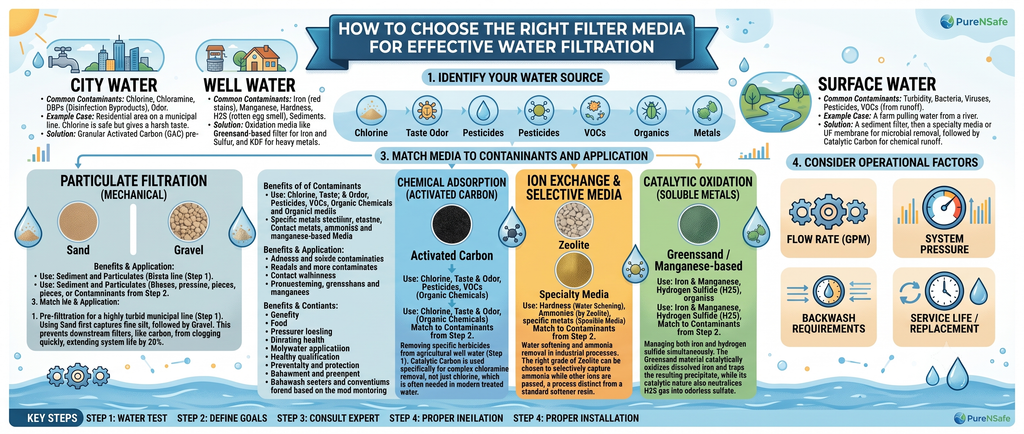
Choosing the right water filter media is one of the most important decisions in designing an effective water filtration system. Different types of water contain different impurities, and no single filtration media is suitable for every application.
Suspended solids, turbidity, iron, manganese, organic compounds, unpleasant odors and other contaminants may require different treatment approaches. Selecting the appropriate filtration media can improve water quality, reduce operational problems and support consistent filtration performance.
Whether the application is residential, commercial or industrial, understanding the characteristics of different filter media helps create a more efficient treatment process.
What Is Water Filter Media?
Water filter media are materials used inside filtration systems to remove specific contaminants from water. Depending on the application, the media may physically trap suspended particles, provide a surface for adsorption or support other treatment mechanisms.
Common filtration media include:
- Silica sand
- Anthracite
- Garnet
- Activated carbon
- Manganese dioxide-based media
- Zeolite
- Gravel and supporting media
Each material has different physical and chemical properties. Therefore, selecting media based only on price may not provide the best long-term result.
Why Filter Media Selection Matters
The performance of a filtration system depends heavily on the media used inside the filter.
The right media can help:
- Reduce suspended particles
- Improve water clarity
- Remove specific contaminants
- Improve filtration efficiency
- Support longer filter runs
- Reduce unnecessary maintenance
- Improve overall treatment performance
On the other hand, unsuitable media can result in frequent backwashing, pressure buildup, poor contaminant removal and inconsistent water quality.
Consider the Quality of the Source Water
The first step in selecting filtration media is understanding the incoming water.
Water analysis can provide information about parameters such as:
- Turbidity
- Total suspended solids
- Iron
- Manganese
- Organic matter
- pH
- Total dissolved solids
- Color
- Odor
For example, a system designed mainly to remove suspended particles may require a different media arrangement than a system treating water containing organic compounds or iron.
A basic water analysis therefore provides a useful foundation for filter media selection.
Silica Sand for Suspended Particle Removal
Silica sand is widely used in conventional water filtration systems. It works primarily through physical filtration, helping capture suspended particles as water passes through the filter bed.
Sand is commonly used in:
- Pressure sand filters
- Multimedia filters
- Water treatment plants
- Pretreatment systems
- Commercial filtration systems
Its effectiveness depends on factors such as particle size, bed depth, filtration rate and system design.
Anthracite in Multimedia Filtration
Anthracite is a lightweight carbonaceous filtration material often used in multimedia filters.
Because anthracite has a lower density than many mineral filter media, it can be positioned above heavier materials such as sand.
A properly designed multimedia bed can provide different filtration zones and improve the utilization of the filter bed.
Anthracite is particularly useful where higher filtration capacity and effective suspended-solids removal are required.
Garnet as a Dense Filter Media
Garnet is a high-density filtration material that can be used as part of a multimedia filter bed.
Its relatively high density allows it to remain at the lower portion of a properly graded multimedia system.
Garnet can help improve the depth filtration characteristics of a filter when combined with other media.
The exact media combination should be determined according to the water characteristics and filtration system design.
Activated Carbon for Organic Compounds and Odor
Activated carbon is different from conventional mineral filtration media because it can remove certain compounds through adsorption.
It is commonly considered for applications involving:
- Unpleasant taste
- Odor
- Chlorine
- Certain organic compounds
- Color-causing compounds
Activated carbon selection may involve considerations such as carbon type, particle size, adsorption characteristics and expected contaminant load.
Why Multimedia Filtration Can Be Effective
Some water treatment applications benefit from combining several filtration media rather than relying on one material.
A multimedia filter may contain layers such as:
Anthracite → Sand → Garnet → Supporting Gravel
The different densities and particle sizes allow the filter bed to perform depth filtration across multiple layers.
However, the exact arrangement should be designed according to the application rather than copied from a standard configuration.
Important Factors When Selecting Filter Media
Several factors should be evaluated before selecting a filtration medium.
1. Target Contaminants
Identify exactly what needs to be removed. Suspended solids, organic compounds, iron and manganese may require different treatment approaches.
2. Media Particle Size
Particle size affects filtration characteristics, pressure loss and contaminant capture.
3. Media Density
Density becomes particularly important in multimedia filter design because different materials need to remain in their intended layers.
4. Filtration Rate
The expected flow rate should be considered when designing the filter bed.
5. Backwashing Requirements
The media must be compatible with the system’s backwash procedure. Incorrect selection can result in media loss or poor bed expansion.
6. Water Chemistry
pH, temperature and other water characteristics can influence treatment performance and media suitability.
Regular Maintenance Is Also Important
Selecting good filtration media is only one part of maintaining water quality.
The filter should also be operated and maintained correctly. Depending on the system, maintenance may include:
- Monitoring pressure drop
- Performing backwashing
- Checking media condition
- Inspecting valves and underdrain systems
- Monitoring treated-water quality
- Replacing media when necessary
Regular monitoring can help identify filtration problems before they affect the complete treatment process.
Final Thoughts
The right water filter media should be selected according to the quality of the source water, target contaminants, filtration rate, system design and operating conditions.
Sand, anthracite, garnet, activated carbon and other specialized media each have their own applications. Instead of selecting a material based solely on cost, water treatment professionals should consider the complete filtration requirement.
A properly selected and maintained media bed can contribute significantly to stable filtration performance and improved water quality.
Best Filter Medias provides information and resources related to water filtration media and water treatment applications, helping readers understand the role of different filtration materials in modern treatment systems.
Frequently Asked Questions (FAQs)
What is water filter media?
Water filter media are materials used in filtration systems to remove suspended particles or specific contaminants from water.
Which media is commonly used for suspended solids?
Silica sand is commonly used for physical removal of suspended particles, while multimedia systems may combine sand with anthracite and other materials.
What is activated carbon used for?
Activated carbon is commonly used for adsorption of certain organic compounds and for reducing chlorine, taste and odor in suitable applications.
Why are multiple filter media used together?
Different media can provide different filtration characteristics, allowing a multimedia filter to utilize the depth of the filter bed more effectively.